
What Actually Happens on an Interior Design Consultation Call
Every project starts the same way. Someone stares at a room that isn't working, has a hundred tabs open of inspiration photos, a Pinterest board that contradicts itself, and a paint swatch or two taped to the wall that's been there for three months. They know something needs to change; they just can't tell if the problem is the layout, the lighting, the couch, or all three.
Then there's the thought that usually stops people before they even reach out: I probably need help, but I have no idea what that actually looks like. Does it mean handing over the whole project? Does it mean a two-hour meeting where you feel like it’s going in circles? Nobody tells you what actually happens, so the not knowing becomes its own kind of stuck.
So let's fix that. Here's exactly what happens on a design consultation call, what you need to bring, and why you really don't need to have it all figured out before we chat.
How Virtual Consultations Actually Work
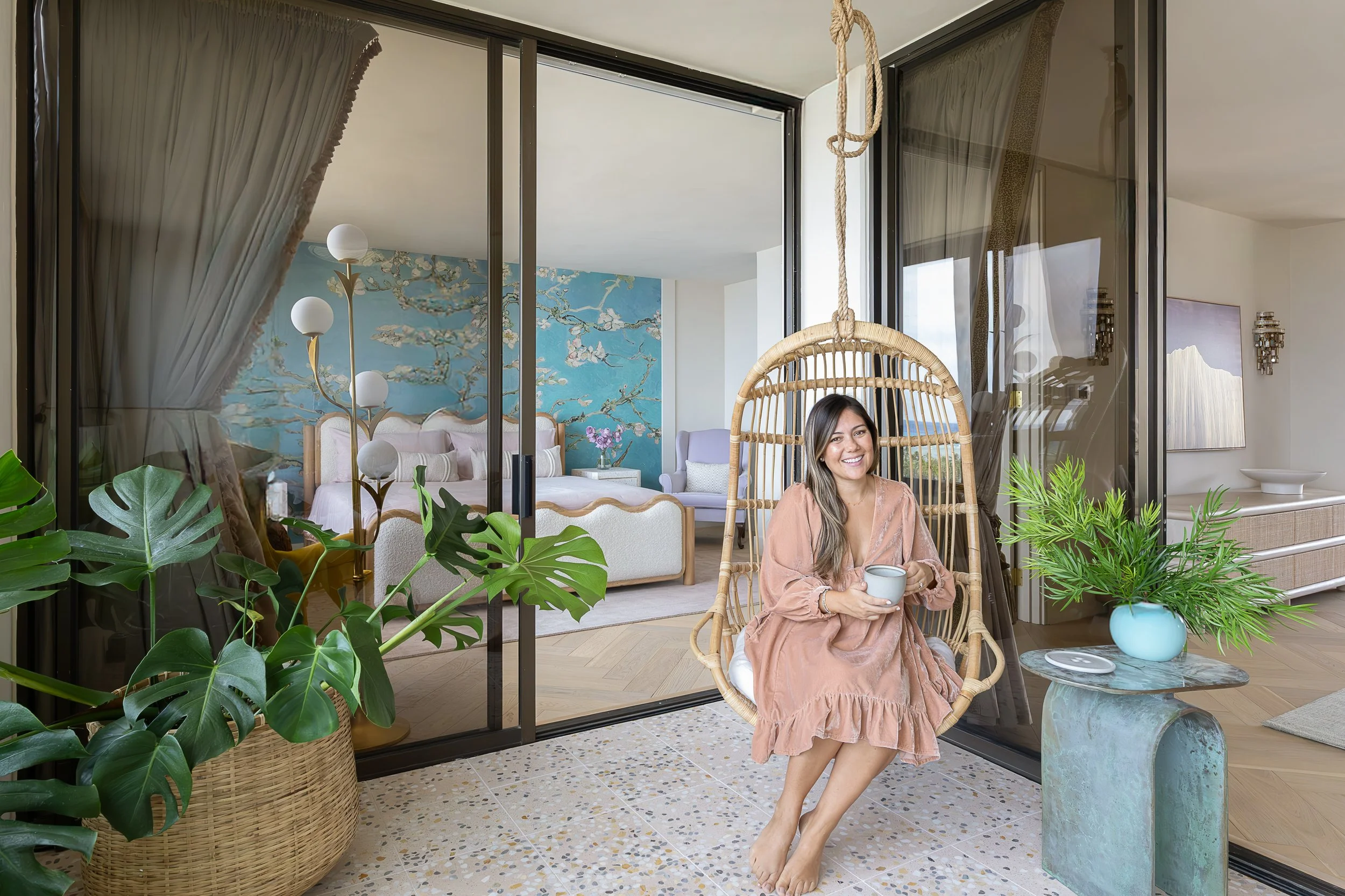
How do you design a room you're not standing in? The truth is, most of what shapes a good design decision doesn't require physical presence. It requires good information: clear photos or video, accurate measurements, honest answers, and someone who knows what questions to ask to fill in the gaps. A video call actually gives us more control over what we're looking at than a rushed in-person walkthrough often does, since we can pause, zoom in, and look at exactly what matters. We’ve been working this way with every client, not as a workaround, but because it's simply how the studio operates. Location and proximity have never been the thing that determines whether a space gets good design.
What a Virtual Consultation Actually Looks Like
Once you book, you'll get a calendar invite with a Google Meet link; that's it, no app to download, no account to create. On the call, you're walking us through your space with your phone camera while we talk, or sharing your screen if you're pulling up a floor plan, a Pinterest board, or measurements you've already got saved. It's less "formal presentation" and more "hey, come look at this with me," which tends to put people at ease faster than an in-person walkthrough does, where there's often a version of showing your home to a stranger.
Why a Camera Can See More Than a Room Does
A video call actually gives us more control over what we're looking at than a rushed in-person walkthrough often does. We can pause on a detail, ask you to walk closer to a wall, zoom in on a finish, or have you turn the camera toward the window so we can see how the light actually hits the room at that hour. In person, you get one pass through a doorway and a lot of "well, it looks different depending on the time of day," said while standing at the wrong time of day. On a call, we can ask you to send a follow-up video at 4 pm if that's what actually matters for the decision.
This Isn't a Workaround, It's the Whole Studio
We work this way with every client, not as a workaround or a downgrade from "the real thing," but because it's simply how the studio operates. There's no physical studio to visit in the first place, and that's by design, not a limitation we're apologizing for. Location and proximity have never been the thing that determines whether a space gets good design. A clear conversation, a good eye, and the right questions do that, whether we're five minutes away or on the other side of an ocean.

Before the Call: What You Actually Need to Prepare
Almost nothing, honestly. But a few things help:
A handful of photos or a screen recording of the space, whatever angle shows the problem
Any inspiration you've been collecting, even if it's a messy Pinterest board or a folder of screenshots that don't match
A rough sense of budget; it doesn't need to be exact
The honest version of how you actually live in the space
That last one matters more than people think. The guest room that's technically "for guests" but has quietly become storage for everything without a home. The counter that's technically a workspace but is really where mail goes to die. That's the stuff that actually shapes good design.
What Happens During the Consultation
This is one-on-one time with Shaolin, built entirely around your project, whether that's the focused half-hour of the mini consultation or the full hour of the standard one. Either way, it's not a sales pitch, not a slideshow, and not a generic checklist run through with every client. It's a real conversation, the kind where you can ask the questions you've been embarrassed to ask a "real" designer, admit you have no idea what half the design terms actually mean, and still walk away with direction that applies to your space instead of a catalog example.
The walkthrough
You show us the space, whether that's a video call where we look around together, photos you've sent ahead, or a screen share of a floor plan. We're looking at proportions, light, flow, what's fighting against what.
The questions we actually ask
These are the questions that get to a layout and a material palette that hold up once the excitement of a mood board wears off. Less "what's your favorite color" and more:
How do you want to feel in this room?
Who else uses this space, and what do they need from it?
What's the actual timeline?
Is anyone in the household going to veto a decision three weeks in?
Talking budget without it being awkward
Budget is usually the part people dread most. Nobody wants to say a number out loud and worry it sounds too small, or watch a designer's face for a reaction. So let's take that off the table early.
We'd rather talk numbers upfront than have you fall in love with a sofa that's nowhere near the range, or spend the whole call dancing around a question neither of us is asking. A rough range is enough. It tells us what direction to point you in, whether that's sourcing something custom or finding a smart, well-made alternative that does the same job for less. It's a practical conversation, not an uncomfortable one, and it usually takes about thirty seconds once you actually say the number.
What Happens After the Call
You'll walk away with:
Clear design direction, so you know what you're actually working toward
Actionable next steps, not a vague "let's stay in touch"
Expert sourcing tips, specific enough that you could start shopping the same day if you wanted to
From there, it's your call. Some people take that direction and run with it themselves. Others want to keep working together on the fuller project. Either way, you're not leaving with more open tabs than you started with.
FAQ
How much does an interior design consultation cost?
This varies by studio and by what's included. A one-hour virtual consultation is designed to be a lower-commitment way to get expert eyes on your space before deciding on anything bigger. Studio Shaolin actually offers three different ways to get time with Shaolin, depending on how deep you need to go.
Complimentary Discovery Call
30 minutes, free
A "let's see if we're a good fit" conversation, no commitment, no cost.
Mini Virtual Consultation
30 minutes, $175
Built for one specific question or decision.
Virtual Consultation
1 hour, $350
The deep dive for layout, materials, and several stacked decisions.
Do I need to know what style I want before the call?
Not necessarily. Coming in with scattered inspiration is completely normal; our conversation is to figure that out together.
Can interior design really be done virtually?
Oh, absolutely. With clear photos, measurements, and a good conversation, a virtual consultation can cover the same ground as an in-person one, and it means you're not limited to proximity.
What if I only need help with one room, not a whole house?
That's exactly what this format is for. It's built for a focused conversation about a specific space or decision, not a full renovation commitment.
Ready to Get Expert Design Guidance?
Whether you need help choosing finishes, reviewing plans, fixing a layout, sourcing furniture, or pulling your home together, a virtual consultation can help you move forward with clarity and confidence.

Studio Shaolin is an award-winning interior design studio based in Honolulu, Hawaiʻi. Founder Shaolin Low is a third-generation designer featured in Architectural Digest, The Wall Street Journal, House Beautiful, and Magnolia Network's Home in Hawaii.